
CISCE 2026

The 8th IEEE International Conference on Communications, Information Systems, and Computer Engineering (CISCE 2026) Grandly Held in Guangzhou
On March 28, 2026, the 8th IEEE International Conference on Communications, Information Systems, and Computer Engineering (CISCE 2026) was grandly held in Guangzhou, China. Jointly hosted by the Institute of Electrical and Electronics Engineers (IEEE) and Guangdong University of Technology, and co-supported by multiple universities including the IEEE Information Theory Society Guangzhou Chapter, Fuzhou University, Guangzhou University, and Xiangtan University, the conference brought together experts, scholars, researchers, and young students from around the world to discuss cutting-edge technologies and future development directions in the fields of communications, information systems, and computer engineering. The conference featured 4 keynote presentations, 2 parallel sub-forums, over 20 oral presentations, and more than 70 on-site poster displays, covering multiple frontier areas such as communications, AI, integrated circuits, and distributed systems, attracting over 160 on-site participants.
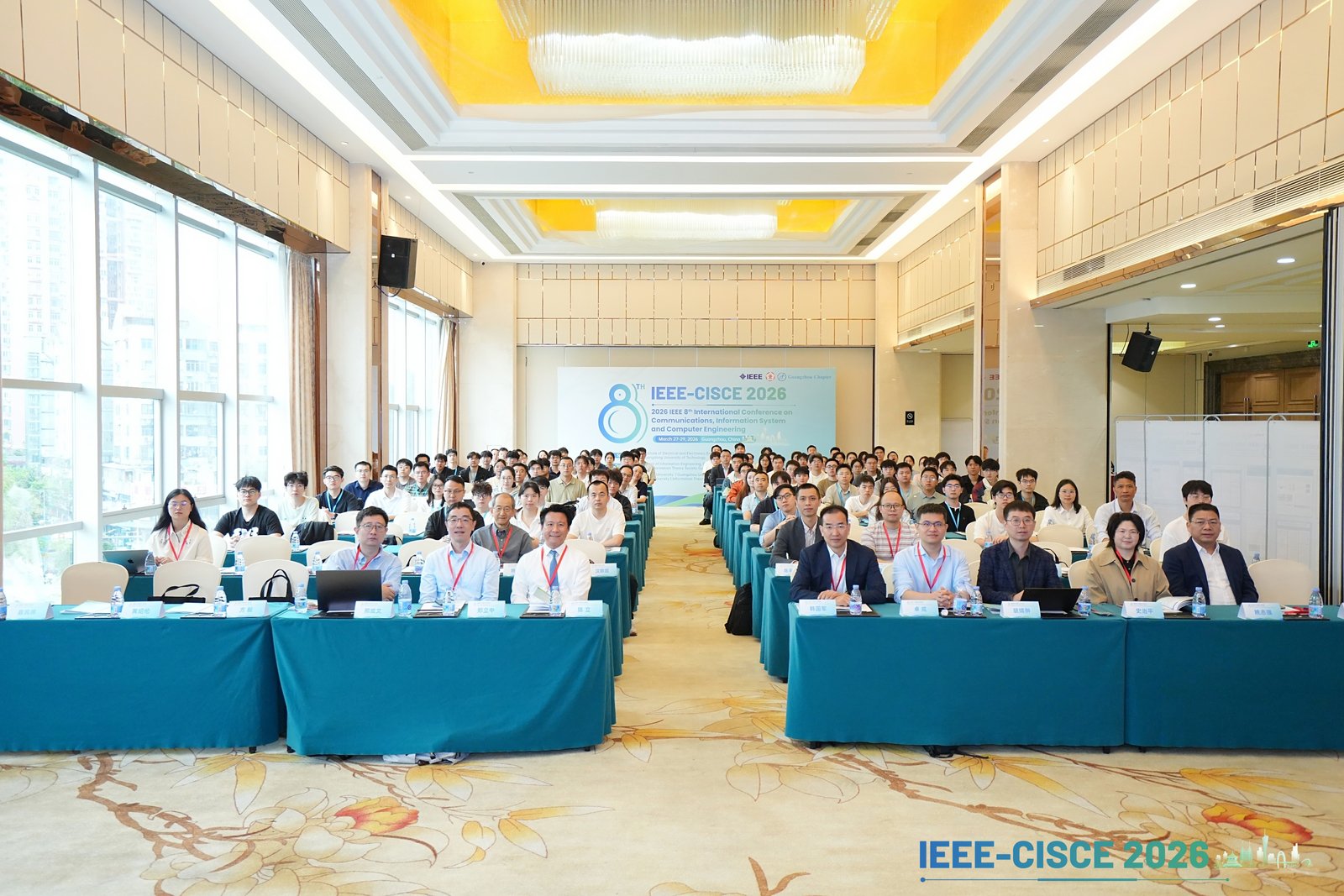
01 Opening Ceremony
On the morning of March 28, the conference officially commenced. The opening ceremony was moderated by Professor Pingping Chen from Fuzhou University. Professor Chen first extended a warm welcome to all guests and participants who had traveled from afar, noting that the active participation of the attending experts and scholars constituted the core strength behind the successful organization of this conference.

Subsequently, the conference specially invited Professor Guojun Han, Dean of the School of Information Engineering at Guangdong University of Technology, to deliver the opening address. In his speech, Professor Han stated that the school has achieved fruitful results in disciplinary development, scientific research innovation, and talent cultivation in recent years. He expressed sincere gratitude to all experts and scholars for their long-term support and looked forward to establishing an open and shared cutting-edge academic platform through this conference to jointly promote innovative development in the fields of communications, information systems, and computer engineering.

Following this, Professor Li Chen, Chair of the IEEE Information Theory Society Guangzhou Chapter and Professor at Sun Yat-sen University, delivered a welcome address on behalf of the Chapter. In his speech, he reviewed the development history of the CISCE conference series, emphasized the importance of interdisciplinary integration in the current wave of technological transformation, expressed full recognition of the conference organization, and expected that the event would inspire new innovative ideas among participating scholars.

02 Keynote Presentations
The keynote session was a core highlight of the conference. Four distinguished scholars delivered academic presentations on cutting-edge topics including artificial intelligence, communication systems, and integrated circuits.
The first keynote speaker was Professor Liuchung Zheng from the Hong Kong University of Science and Technology (IEEE Fellow, Editor-in-Chief of the IEEE Transactions on Information Theory). His presentation was titled "Key Elements of 'AI for Engineering' – Taking Reservoir Computing as an Example." Professor Zheng systematically elaborated on the core mechanisms of artificial intelligence in engineering applications and demonstrated the potential of AI models in complex systems using reservoir computing as a case study.

The second keynote speaker was Professor Cheng Zhuo from Zhejiang University (Qiushi Distinguished Professor, Associate Dean of the School of Integrated Circuits). His presentation was titled "AI-Driven Virtual Manufacturing of Integrated Circuits." Professor Zhuo introduced the applications of artificial intelligence in VLSI design and electronic design automation (EDA), showcasing cutting-edge advancements in AI-enabled chip manufacturing.

The third keynote speaker was Professor Chengwen Xing from Beijing Institute of Technology. His presentation was titled "Energy Efficiency Design for Mobile Antenna-Aided MU-MIMO Systems." Professor Xing deeply explored energy efficiency optimization issues in high-frequency band communication systems, providing innovative ideas for next-generation wireless communication systems.

The fourth keynote speaker was Professor Yuchong Hu from Huazhong University of Science and Technology (National Young Talent Program Awardee). His presentation was titled "Research on Performance Optimization Techniques for Distributed Training Systems Based on Gradient Sparsification." Professor Hu focused on the communication bottleneck in large-scale distributed AI training and proposed a series of performance optimization methods.

03 Parallel Sub-forums
In the afternoon, the conference proceeded to parallel sub-forums, held simultaneously in the New York Hall and Beijing Hall, featuring both invited and oral presentations.
Sub-forum I was moderated by Professor Chang Liu from Guangdong University of Technology. Three invited guests delivered presentations: Professor Jingtao Yao from the University of Regina: "Three-Way Clustering in Machine Learning: Methods and Future Directions"; Associate Professor Shaolun Huang from Tsinghua Shenzhen International Graduate School: "Mathematical Theory of In-Context Learning"; and Associate Professor Congduan Li from Sun Yat-sen University: "UDFed: A Universal Defense Scheme Against Multiple Poisoning Attacks in Federated Learning."

Sub-forum II was moderated by Associate Professor Ling Liu from Xidian University. Invited presentations included: Associate Professor Ling Liu from Xidian University: "Polarization Feedback Coding: A New Framework for Finite-Length Performance Analysis"; Associate Professor Pengchao Han from Guangdong University of Technology: "Federated Learning under Model-as-a-Service: Joint Optimization of Training and Inference"; and Dr. Zhongjun Yang from Sun Yat-sen University: "Improving Successive Cancellation Decoding of Long Polar Codes via Perturbed Posterior Log-Likelihood Ratios and Theoretical Analysis."

04 Oral Presentation Session
The afternoon oral presentation sessions were held concurrently in two sub-forums, featuring over 20 high-quality papers. Research topics covered multiple frontier areas including intelligent antenna optimization, distributed systems, edge computing, multimodal fusion, communication anti-jamming, and IoT security. Early-career researchers from organizations such as ZTE Corporation, National University of Defense Technology, Southern University of Science and Technology, Beijing University of Posts and Telecommunications, Shenzhen University, Inner Mongolia University, and Guangdong University of Technology presented their latest research findings, sparking lively on-site discussions and creating a strong academic atmosphere.
05 Tea Breaks and Networking
Ample tea breaks and free networking time were arranged during the conference, allowing participants to engage in in-depth discussions on shared academic interests in a relaxed atmosphere, fostering cross-institutional and cross-disciplinary collaboration intentions.
06 Awards and Recognition
Following the oral presentation sessions, the conference organizing committee conducted on-site evaluations and presented three awards: Outstanding Paper Award, Outstanding Young Scholar Presentation Award, and Outstanding Poster Award. Award ceremonies were held in each sub-forum, where award-winning scholars came on stage to receive their honors and have group photos taken. The conference moderators, on behalf of the organizing committee, extended warm congratulations to all award winners and sincere thanks to all experts involved in the evaluation process.
07 Closing and Outlook
With the successful conclusion of the afternoon agenda, the 8th IEEE International Conference on Communications, Information Systems, and Computer Engineering (CISCE 2026) came to a triumphant close. Participating representatives expressed that the conference not only broadened their academic horizons but also laid a solid foundation for future research collaboration.
The conference organizing committee extended heartfelt thanks to all supporting organizations, keynote speakers, participating scholars, and staff, and looked forward to reuniting with everyone at future CISCE conferences to jointly promote sustained innovation and development in the fields of communications and computer engineering.